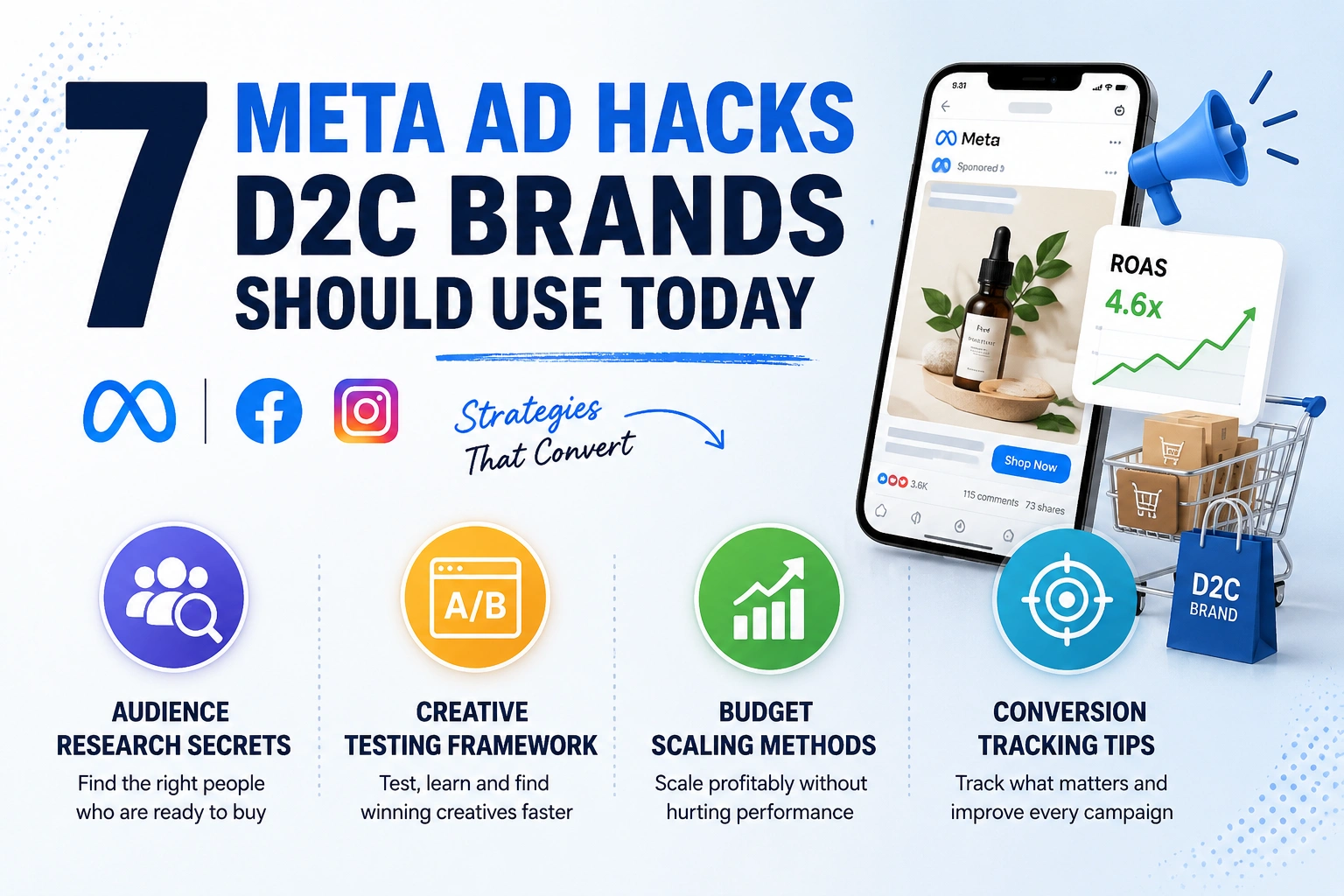
Audience Research Secrets: The Foundation of High-Converting Meta Ads
Many D2C and e-commerce brands spend hours creating ad creatives. They also spend significant budgets on advertising campaigns. Yet, many still struggle to achieve profitable results. The reason is often simple. They do not understand their audience deeply enough.
Before launching any Meta advertising campaign, you need to know exactly who you are talking to. Great audience research helps you create ads that feel relevant. When people feel understood, they are more likely to engage with your content and purchase your products.
The good news is that audience research is not complicated. You do not need expensive tools or advanced marketing skills. You simply need the right approach and a willingness to listen to your customers.
Start With Customer Problems, Not Product Features
One of the biggest mistakes brands make is focusing too much on product features. Your audience rarely wakes up excited about product specifications. They care about solving a problem.
Think about why people buy your product. What challenge are they facing? What frustration do they want to remove from their lives? Understanding these motivations gives you valuable marketing insights.
For example, if you sell skincare products, customers may not care about ingredients first. They may care about gaining confidence. They may want clearer skin before an important event. The emotional reason often matters more than the technical details.
When you identify customer problems, your ad messages become more relatable. Your audience feels like you understand their situation. This connection often leads to better engagement and higher conversions.
Spend time reading customer reviews. Browse social media comments. Look at product feedback. You will discover recurring problems and desires. These insights can become powerful advertising angles.
Learn Where Your Audience Already Talks
Your audience leaves clues everywhere online. You simply need to know where to look.
Social media platforms are excellent research sources. Facebook groups, Instagram comments, Reddit communities, and online forums reveal real customer conversations. People openly discuss challenges, goals, frustrations, and product experiences.
Pay attention to the words people use. Notice common questions and concerns. These phrases can inspire future ad copy and creative concepts.
You can also study competitors. Look at their most engaging social media posts. Read the comments carefully. Customers often reveal what they like, dislike, and wish existed.
This process helps you understand audience language. Instead of guessing what resonates, you can communicate using words your audience already understands.
When your ads sound familiar and natural, they feel less like advertisements. They feel more like helpful solutions.
Discover Buying Triggers and Emotional Motivations
People often believe they make logical buying decisions. In reality, emotions influence many purchases.
Your audience may want convenience, confidence, status, comfort, security, or happiness. Understanding these emotional drivers helps you create stronger marketing messages.
Ask yourself what happens after someone uses your product. How does their life improve? What feeling do they experience?
For example, someone buying fitness equipment may want better health. However, they may also want confidence and self-esteem. A parent purchasing educational toys may want peace of mind. They want to feel they are making a good choice.
These emotional triggers can shape your ad creatives and messaging.
The best Meta ads often focus on outcomes rather than features. They show the transformation customers want. They highlight benefits that matter in everyday life.
When your audience sees a desirable outcome, they become more interested in learning about your product.
Use Existing Customer Data Wisely
Your current customers are one of your most valuable research resources.
Look at your previous sales data. Identify patterns among your best customers. Consider factors such as age, interests, purchase behavior, and product preferences.
Email responses can also provide useful insights. Customer support conversations often reveal common concerns and objections. These discussions help you understand what prevents people from buying.
You can even conduct simple surveys. Ask customers why they purchased your product. Ask what problem they wanted to solve. Their answers may surprise you.
Many successful brands build entire campaigns around customer feedback. Real customer language often performs better than marketing jargon.
The more you understand existing buyers, the easier it becomes to attract similar customers through Meta advertising.
Build Audience Segments for Better Targeting
Not every customer wants the same thing. Different people buy products for different reasons.
This is why audience segmentation is important. Instead of targeting everyone with one message, create smaller audience groups.
You may have first-time visitors, repeat customers, loyal fans, and abandoned cart users. Each group requires different messaging.
A first-time visitor may need education and trust-building. A returning customer may respond better to product recommendations. Someone who abandoned a cart may need reassurance or a special offer.
Segmented audiences allow you to deliver more personalized experiences. Personalized advertising usually generates better engagement and stronger results.
Meta’s advertising platform offers powerful tools for audience segmentation. However, success begins with understanding customer behavior first.
Turn Research Into Better Meta Ads
Audience research is only valuable when you apply it effectively.
Use your findings to create stronger headlines. Build better creative concepts. Develop more relevant offers. Improve landing page messaging.
When you understand your audience deeply, advertising becomes easier. You stop guessing and start making informed decisions.
The most successful D2C brands rarely rely on luck. They invest time understanding customer needs, motivations, and behaviors. This knowledge guides every marketing decision.
Before launching your next Meta campaign, spend time researching your audience. The insights you discover may become your biggest competitive advantage.
Great ads start with great audience understanding. The better you know your customers, the easier it becomes to attract, engage, and convert them.
Creative Testing Framework: The Secret Behind Winning Meta Ads
Many D2C and e-commerce brands believe successful Meta ads come from creativity alone. While creativity matters, testing matters even more.
The truth is simple. Nobody can accurately predict which ad creative will become a winner. Even experienced marketers are surprised by test results. That is why successful brands rely on a creative testing framework instead of assumptions.
A creative testing framework helps you discover what your audience truly responds to. Rather than guessing, you collect data and let real customer behavior guide your decisions.
When you build a testing system, you stop wasting budget on weak ideas. Instead, you focus on creatives that drive engagement, leads, and sales.
Why Testing Beats Guessing Every Time
You may love a particular ad design. Your team may think a video looks amazing. However, your audience may feel completely different.
Meta advertising is not about what you like. It is about what your customers respond to.
This is why testing is essential. It removes opinions from the decision-making process. Instead of debating ideas, you let performance data reveal the winner.
Imagine testing two different ad headlines. One focuses on saving money. The other focuses on convenience. You may expect one result, but customers may prefer the opposite.
Without testing, you would never know.
Testing allows you to discover hidden opportunities. Sometimes the simplest creative becomes the best performer. Sometimes a basic smartphone video outperforms an expensive production.
The lesson is clear. Trust data more than personal preferences.
Test One Variable at a Time
One common mistake is changing too many things at once.
For example, imagine you change the headline, image, offer, and audience simultaneously. If results improve, you will not know which change caused success.
A better approach is testing one variable at a time.
You can test:
- Different headlines
- Different images
- Different videos
- Different calls to action
- Different offers
- Different hooks
When only one element changes, the results become easier to understand.
This approach gives you cleaner data and better insights. Over time, small improvements create major performance gains.
Think of testing like a science experiment. The clearer your test, the more valuable the results become.
Start With Creative Hooks First
The first few seconds of your ad are extremely important.
People scroll through social media quickly. If your ad fails to grab attention, everything else becomes irrelevant.
This is why many successful advertisers start by testing hooks.
A hook is the opening message that stops someone from scrolling.
You can test different hook styles such as:
- Problem-focused hooks
- Question-based hooks
- Curiosity-driven hooks
- Bold statements
- Customer success stories
- Surprising statistics
For example, one hook might say, “Still struggling to grow your online sales?”
Another might say, “This simple change increased sales by 43%.”
Both messages address the same topic but create different emotional reactions.
Testing multiple hooks helps identify what captures attention fastest.
Once you find a winning hook, you can build additional creatives around it.
Create Multiple Creative Angles
Many brands test only one message. This limits growth opportunities.
Instead, create several creative angles for the same product.
A creative angle is the unique perspective you use to present your offer.
For example, if you sell fitness equipment, you could create ads focused on:
- Saving gym membership costs
- Working out at home
- Building confidence
- Improving health
- Saving time
Each angle speaks to a different customer motivation.
Some customers care about convenience. Others care about appearance. Others want better health.
Testing different angles helps uncover which message resonates most strongly with your audience.
Often, the best-performing angle is not the one you originally expected.
Use a Structured Testing Process
Random testing creates random results.
Instead, follow a consistent testing process.
Start by generating several creative ideas. Next, prioritize the most promising concepts. Launch small tests with controlled budgets. Measure performance carefully.
Track important metrics such as:
- Click-through rate
- Cost per click
- Conversion rate
- Cost per purchase
- Return on ad spend
After collecting enough data, pause weak performers and scale winning creatives.
Then repeat the process.
This cycle helps you continuously improve campaign performance.
Successful Meta advertisers rarely stop testing. They understand that audience behavior changes over time.
A creative that performs well today may become less effective later.
Continuous testing keeps your campaigns fresh and competitive.
Learn From Winners and Losers
Many marketers focus only on winning ads.
However, losing ads can teach valuable lessons too.
Every failed creative provides feedback. It shows what your audience does not want.
Maybe the message was unclear. Maybe the offer was weak. Maybe the visual failed to capture attention.
Instead of viewing failed tests negatively, treat them as learning opportunities.
The more tests you run, the more audience insights you collect.
Over time, these insights help you create stronger creatives faster.
You begin recognizing patterns. You understand what grabs attention and what drives conversions.
This knowledge becomes a powerful competitive advantage.
Build a Creative Testing Culture
The best D2C brands treat testing as an ongoing process, not a one-time activity.
They constantly explore new ideas. They challenge assumptions. They search for better ways to communicate with customers.
You can adopt the same mindset.
Encourage experimentation. Test new concepts regularly. Stay curious about audience behavior.
Remember that no creative works forever. Trends change. Platforms evolve. Customer preferences shift.
A strong creative testing framework helps you adapt quickly.
Instead of relying on luck, you build a system that consistently finds winners.
When you combine creativity with disciplined testing, your Meta advertising becomes more predictable and profitable.
The brands that win long term are not always the most creative. They are often the most committed to learning from data.
That is the real power of a creative testing framework. It transforms advertising from guesswork into a repeatable growth engine.
Budget Scaling Methods: Grow Your Meta Ads Without Breaking Performance
Every D2C and e-commerce brand dreams about finding a winning Meta ad campaign. Seeing consistent sales feels exciting. However, a new challenge appears quickly. How do you increase results without hurting performance?
This is where budget scaling becomes important.
Many advertisers make the mistake of increasing budgets too aggressively. They see strong results and immediately double spending. Unfortunately, this often causes performance to drop.
Successful scaling requires patience and strategy. The goal is not simply spending more money. The goal is generating more profitable sales.
When you understand proper budget scaling methods, you can grow campaigns steadily while protecting your return on investment.
Why Scaling Too Fast Can Hurt Results
Imagine finding a campaign that generates excellent sales at a low cost.
Naturally, you want more sales. Many advertisers respond by making a huge budget increase overnight.
The problem is that Meta’s algorithm needs time to adjust.
When you dramatically increase spending, the platform must find more people quickly. This often reduces targeting efficiency and increases costs.
Think of it like watering a plant.
Giving the right amount helps it grow. Flooding it suddenly creates problems.
The same principle applies to Meta advertising.
Gradual growth usually performs better than aggressive changes.
If a campaign is producing strong results, treat it carefully. Protect its momentum while increasing reach strategically.
Scale Winning Campaigns, Not Average Ones
Not every campaign deserves a larger budget.
Before scaling, make sure your campaign has already proven itself.
Look for consistent performance over several days. Review key metrics carefully.
Ask yourself:
- Is the campaign generating profitable sales?
- Is the return on ad spend healthy?
- Is the conversion rate stable?
- Is customer acquisition cost acceptable?
If performance remains strong, the campaign may be ready for scaling.
Avoid scaling campaigns based on emotions. Excitement can lead to poor decisions.
Instead, let data guide your actions.
A campaign that performs well consistently has a better chance of handling larger budgets successfully.
Use Gradual Budget Increases
One of the safest scaling methods involves increasing budgets slowly.
Rather than doubling spending, make smaller adjustments.
Many advertisers increase budgets by approximately 10 to 20 percent at a time.
This allows Meta’s algorithm to adapt smoothly.
For example, if your daily budget is $100, increase it to $110 or $120 first.
Monitor performance for several days before making another adjustment.
This approach may seem slower. However, it often produces better long-term results.
You reduce the risk of disrupting campaign performance while maintaining steady growth.
Patience often beats speed when scaling advertising budgets.
Horizontal Scaling Creates New Opportunities
Budget increases are not the only scaling strategy.
Another effective method is horizontal scaling.
Instead of increasing one campaign’s budget significantly, you launch additional campaigns or ad sets.
This allows you to reach new audience segments without overloading a single campaign.
For example, you can create campaigns targeting:
- Different interests
- Different age groups
- Lookalike audiences
- Previous website visitors
- Customer lists
Each audience represents a new opportunity for growth.
Horizontal scaling spreads risk across multiple campaigns.
If one campaign experiences performance issues, others can continue generating results.
Many successful brands use both vertical and horizontal scaling together.
This creates a balanced growth strategy.
Expand Winning Creative Variations
Creative fatigue becomes a common challenge during scaling.
As your ads reach more people, audiences may become less responsive.
This can increase costs and reduce performance.
One solution is expanding creative variations.
When a creative performs well, create several new versions inspired by the same concept.
You can test:
- Different headlines
- New video formats
- Alternative visuals
- Different customer testimonials
- New calls to action
This keeps campaigns fresh while preserving successful messaging.
Meta’s algorithm benefits from having multiple strong creatives available.
Fresh creatives help maintain engagement and improve long-term scalability.
The best advertisers constantly feed new creative ideas into their campaigns.
Watch Key Metrics During Scaling
Scaling without monitoring performance is risky.
As budgets increase, pay close attention to important metrics.
Track indicators such as:
- Cost per purchase
- Return on ad spend
- Click-through rate
- Conversion rate
- Frequency score
These numbers reveal how your campaigns are responding to increased spending.
If costs rise dramatically, slow down your scaling efforts.
If conversion rates remain stable, you may continue growing budgets carefully.
Think of these metrics as your campaign dashboard.
They provide valuable signals that help guide decision-making.
Ignoring performance data can lead to unnecessary losses.
Avoid Emotional Scaling Decisions
Advertising results often create strong emotions.
A great sales day can make you want to increase budgets immediately.
A weak day may tempt you to pause campaigns too quickly.
Both reactions can be dangerous.
Meta advertising performance naturally fluctuates.
One day rarely tells the complete story.
Instead of reacting emotionally, focus on trends.
Review performance over several days before making major changes.
This creates more stable decision-making.
Professional advertisers rely on systems and data rather than emotions.
The same approach can help you scale more effectively.
Build a Long-Term Growth Mindset
Successful budget scaling is not a one-time event.
It is an ongoing process of testing, learning, and optimization.
As your business grows, new opportunities will appear.
New audiences become available. New creatives emerge. New offers attract attention.
The brands that scale successfully continue refining their campaigns.
They stay flexible and adapt to changing market conditions.
Most importantly, they understand that sustainable growth takes time.
Rapid growth sounds exciting. Predictable growth is usually more profitable.
When you combine strong creatives, proven audiences, and careful budget increases, scaling becomes much easier.
Turn Scaling Into a Repeatable System
The ultimate goal is creating a repeatable growth system.
You find winning campaigns. You validate performance. You scale gradually. You monitor results. Then you repeat.
This process removes much of the uncertainty from advertising.
Instead of hoping for success, you follow a proven framework.
Over time, your confidence grows because your decisions are backed by data.
Budget scaling is not about spending more money. It is about spending smarter.
When approached correctly, scaling allows you to reach more customers, generate more sales, and grow your brand consistently.
That is why successful D2C brands treat scaling as a disciplined process rather than a lucky event. The more structured your approach becomes, the easier it is to turn winning Meta ads into long-term business growth.
Leave a Comment