
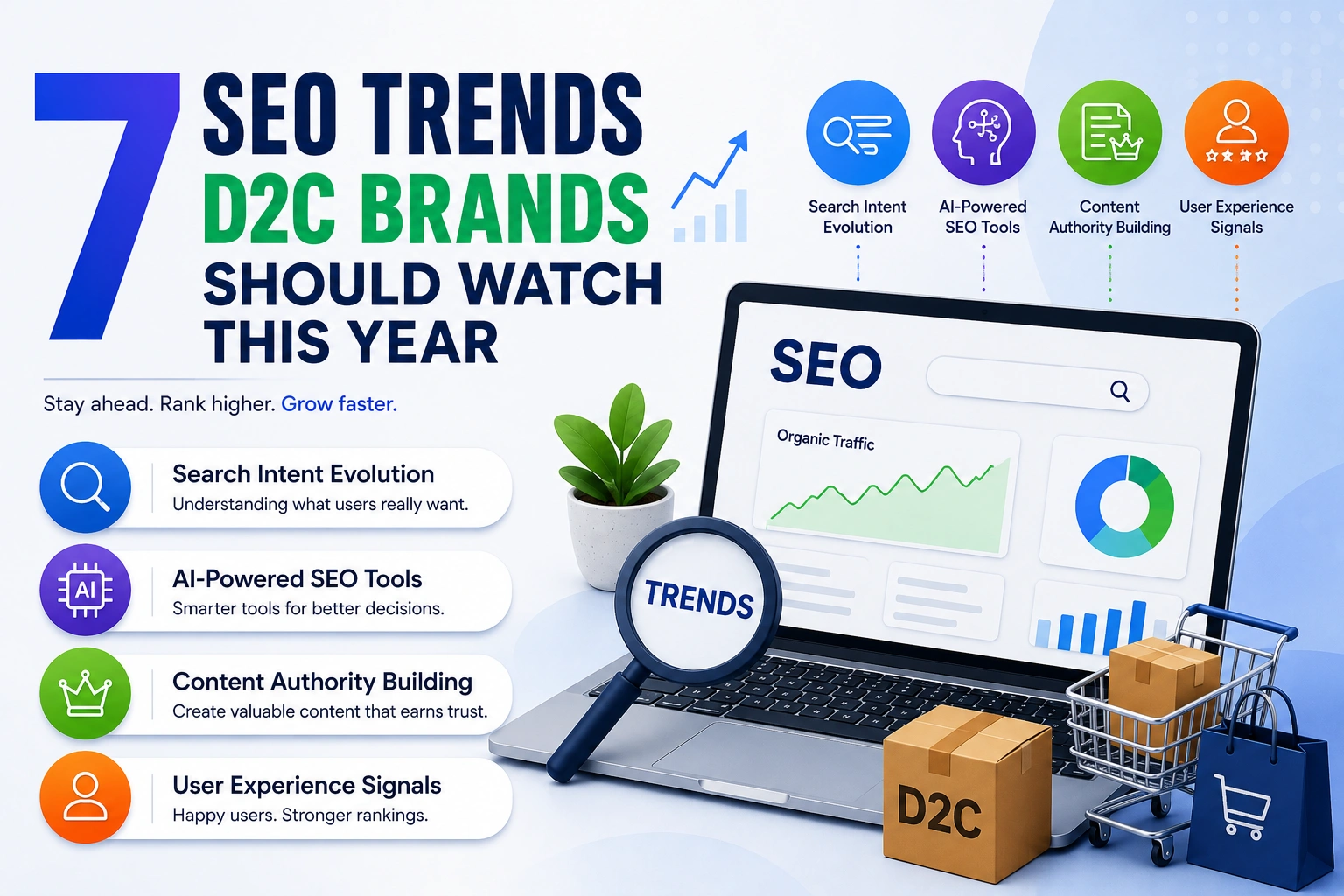
Search Intent Evolution: Why Understanding Search Behavior Matters More Than Ever
SEO has changed dramatically over the years. In the early days, ranking often depended on keywords alone. Today, search engines are much smarter.
Google no longer focuses only on matching words. It focuses on understanding what people actually want.
This shift has transformed how SEO works for D2C and e-commerce brands.
Modern SEO success depends on understanding search intent. If you understand why people search, you can create content that truly helps them.
When your content matches user intent, visitors stay longer, engage more, and convert more often.
That is why search intent evolution has become one of the most important SEO trends for growing brands.
Let’s explore how search behavior is changing and what it means for your business.
Search Intent Is No Longer Just About Keywords
Many businesses still focus heavily on keyword volume.
While keywords remain important, they only tell part of the story.
The real question is what the searcher wants to achieve.
For example, someone searching “best wireless earbuds” has a different goal than someone searching “buy wireless earbuds online.”
Both searches involve similar products.
However, their intentions are different.
The first person is researching options.
The second person is much closer to purchasing.
Google understands these differences.
That is why search results often vary based on intent rather than exact keywords.
When you create content around user goals instead of keywords alone, your SEO strategy becomes much stronger.
The Four Main Types of Search Intent
Understanding search intent becomes easier when you know the major categories.
Most searches fall into four primary groups.
The first is informational intent.
These users want answers, guidance, or education.
Examples include:
- How to choose running shoes
- What is SEO
- Benefits of organic skincare
The second is navigational intent.
These users already know where they want to go.
Examples include:
- Amazon login
- Nike official website
- YouTube homepage
The third is commercial intent.
These users are researching products before making a purchase.
Examples include:
- Best gaming laptop under $1000
- Top fitness trackers comparison
- Shopify vs WooCommerce
The fourth is transactional intent.
These users are ready to take action.
Examples include:
- Buy office chair online
- Order protein powder
- Book SEO consultation
Each intent requires a different content strategy.
Understanding the difference helps you create more relevant content.
Searchers Expect Faster Answers
Modern internet users are impatient.
People want answers quickly.
They do not want to read unnecessary information before finding value.
This has influenced Google’s ranking priorities.
Search engines increasingly reward content that delivers answers efficiently.
This does not mean creating shorter content.
It means making information easy to find and understand.
Use clear headings.
Provide direct answers.
Structure content logically.
Help users achieve their goals without confusion.
The easier your content feels, the more likely visitors are to stay engaged.
Positive engagement signals often support stronger SEO performance.
Voice Search Is Changing Search Behavior
Voice assistants have influenced how people search online.
When typing, users often enter short phrases.
When speaking, they use natural language.
For example, someone might type:
“Best running shoes.”
The same person may ask:
“What are the best running shoes for beginners?”
This creates longer and more conversational searches.
These searches often reveal stronger intent.
Voice search encourages brands to focus on natural language content.
It also increases the importance of answering specific questions.
The more naturally your content aligns with real conversations, the better it can perform.
Search Intent Changes Throughout the Customer Journey
Customers rarely move from discovery to purchase instantly.
Their search intent evolves over time.
A potential customer may begin with informational searches.
Later, they move into comparison mode.
Eventually, they search with buying intent.
For example:
Stage one:
“How to improve sleep quality”
Stage two:
“Best mattresses for back pain”
Stage three:
“Buy orthopedic mattress online”
Notice how intent changes at every stage.
Smart brands create content for the entire journey.
This helps attract visitors earlier and guide them toward conversion.
The more touchpoints you create, the more opportunities you generate.
AI Is Making Search Engines Smarter
Artificial intelligence has significantly improved Google’s ability to understand intent.
Search engines now analyze context more effectively.
They understand relationships between topics, entities, and user goals.
This means keyword stuffing no longer works.
Repeating the same phrase excessively provides little value.
Instead, content must demonstrate genuine expertise and relevance.
Google wants to deliver the most helpful result.
Brands that focus on helping users often perform better in search results.
The future of SEO revolves around usefulness, not manipulation.
Content Must Match Intent Exactly
One common SEO mistake is creating content that mismatches user expectations.
Imagine someone searches for product comparisons.
Instead of receiving a comparison guide, they land on a sales page.
This creates frustration.
Users leave quickly because their needs were not met.
Google notices these engagement patterns.
Poor user satisfaction can impact rankings.
This is why content alignment matters.
Ask yourself:
What does the searcher expect to find?
Then build your content around that expectation.
The closer the match, the stronger the experience.
Use Search Intent to Improve Product Pages
Search intent is not only useful for blogs.
It can improve product pages as well.
Customers often arrive with specific questions.
They may wonder about pricing, benefits, shipping, materials, or product comparisons.
Addressing these questions directly improves user experience.
It also supports conversion optimization.
Helpful product pages often perform better in both SEO and sales.
When visitors find answers quickly, they feel more confident purchasing.
Search intent and conversion optimization work together naturally.
Analyze Search Queries Regularly
Search behavior constantly evolves.
New trends emerge.
Customer priorities change.
Technology influences how people search.
This means search intent research should never stop.
Review your search performance regularly.
Analyze search queries.
Identify patterns.
Look for new opportunities.
Pay attention to customer questions.
These insights help guide future content creation.
Brands that stay connected to audience needs often outperform competitors.
Build an Intent-First SEO Strategy
The most successful SEO strategies start with people, not algorithms.
Search engines want to satisfy users.
Your content should have the same goal.
Instead of asking:
“What keywords should I target?”
Ask:
“What problems should I solve?”
This simple shift changes everything.
You create more helpful content.
You attract better-qualified visitors.
You build stronger audience trust.
Most importantly, you align with how modern search engines operate.
The Future of SEO Is Understanding People
Search intent evolution reflects a bigger trend.
Search engines are becoming better at understanding human behavior.
As technology improves, user intent will become even more important.
Brands that focus only on keywords may struggle.
Brands that understand customer needs will continue growing.
When you create content that genuinely helps people achieve their goals, SEO becomes much easier.
That is why search intent remains one of the most powerful concepts in modern SEO. The better you understand what users want, the better you can serve them, rank higher, and build sustainable organic growth for your brand.
AI-Powered SEO Tools: The Future of Smarter Organic Growth
SEO has never been simple. You need to research keywords, analyze competitors, create content, monitor rankings, and improve user experience.
For many D2C and e-commerce brands, these tasks can feel overwhelming.
Fortunately, artificial intelligence is changing the game.
AI-powered SEO tools help businesses work faster, make smarter decisions, and uncover opportunities that might otherwise remain hidden.
Instead of spending hours on manual research, you can now use AI to streamline many SEO activities.
The goal is not replacing human creativity. The goal is enhancing your capabilities.
When used properly, AI tools can help you create better content, improve rankings, and attract more qualified visitors.
That is why AI-powered SEO tools have become one of the most important trends for growing brands.
Why AI Is Transforming SEO
Search engines process enormous amounts of information every second.
They analyze content quality, user behavior, search intent, and countless ranking signals.
Keeping up with these changes manually can be difficult.
AI helps simplify this challenge.
Modern AI tools can analyze large datasets quickly.
They identify patterns that humans might overlook.
For example, AI can discover keyword opportunities, content gaps, and search trends within minutes.
Tasks that once required hours can now be completed much faster.
This efficiency allows you to focus more on strategy and creativity.
Instead of spending time gathering information, you spend more time acting on insights.
AI Makes Keyword Research Faster
Keyword research remains one of the foundations of SEO.
However, traditional keyword research can be time-consuming.
You may need to review hundreds of search terms before finding valuable opportunities.
AI tools help accelerate this process.
They analyze search patterns and identify related keyword ideas automatically.
Many tools can group keywords by search intent.
Others suggest long-tail opportunities with lower competition.
For example, if you sell fitness products, AI may uncover specific searches related to home workouts or recovery equipment.
These insights help you build stronger content strategies.
The faster you discover opportunities, the faster you can create content that attracts visitors.
Create Better Content With AI Assistance
Content creation remains one of the most important parts of SEO.
Search engines reward content that helps users solve problems.
AI can support content development in several ways.
It can generate topic ideas.
It can suggest article structures.
It can identify important subtopics.
It can even highlight questions people frequently ask.
This information helps you create more comprehensive content.
However, AI should support your expertise rather than replace it.
The most effective content combines AI efficiency with human insight.
You understand your audience best.
AI simply helps organize information and identify opportunities.
When both work together, content quality often improves significantly.
Find Content Gaps Before Competitors Do
One major advantage of AI-powered SEO tools is content gap analysis.
A content gap is a topic your audience wants but your website does not currently cover.
AI can compare your content against competitors.
It identifies missing topics, keywords, and opportunities.
This helps you discover areas where you can gain visibility.
Imagine your competitors rank for several valuable searches while your website does not.
AI can highlight those opportunities quickly.
Instead of guessing what content to create next, you make decisions based on data.
This approach often leads to more effective content planning.
Improve On-Page SEO More Efficiently
Optimizing individual pages requires attention to many details.
You need strong headings, relevant keywords, proper structure, and readable content.
AI-powered tools can evaluate these elements automatically.
They provide suggestions for improvement.
For example, an AI tool may recommend:
- Better heading structure
- Missing keyword variations
- Improved readability
- Stronger internal linking
- Enhanced content depth
These recommendations help strengthen page quality.
The process becomes faster and more consistent.
Small improvements across multiple pages can create meaningful SEO gains.
Predict Search Trends Earlier
One of the most exciting benefits of AI involves trend identification.
Consumer interests change constantly.
New products emerge. Markets evolve. Search behavior shifts.
AI tools can analyze search data and identify emerging trends.
This allows you to create content before competitors notice the opportunity.
Early content creation often provides ranking advantages.
For D2C brands, trend forecasting can be especially valuable.
You gain insights into changing customer interests.
This information supports both content strategy and product marketing efforts.
The sooner you spot trends, the better positioned you become.
AI Helps Analyze Competitors Smarter
Competitor analysis is another area where AI shines.
Traditional competitor research often involves reviewing multiple websites manually.
AI tools simplify this process.
They can analyze competitor rankings, content performance, backlinks, and keyword strategies.
This provides a clearer picture of the competitive landscape.
You discover what works in your industry.
You identify areas where competitors are succeeding.
You also uncover weaknesses that create opportunities.
The goal is not copying competitors.
The goal is learning from market data and creating something better.
Use AI for Technical SEO Insights
Technical SEO can seem intimidating.
Issues involving crawlability, indexing, page speed, and site structure often require detailed analysis.
AI-powered tools make this easier.
They scan websites and identify technical problems quickly.
Common issues may include:
- Broken links
- Duplicate content
- Slow-loading pages
- Missing metadata
- Mobile usability concerns
Fixing these problems improves user experience and search engine visibility.
AI helps prioritize issues based on potential impact.
This allows you to focus on improvements that matter most.
Remember That Human Expertise Still Matters
Despite its power, AI is not a complete solution.
Search engines prioritize helpful, trustworthy, and valuable content.
Human expertise remains essential.
AI can provide recommendations.
It can organize information.
It can speed up research.
However, it cannot fully replace genuine experience and understanding.
Your unique insights, brand voice, and customer knowledge remain important advantages.
The best SEO strategies combine AI efficiency with human creativity.
This balance often produces the strongest results.
Build a Smarter SEO Workflow
AI-powered SEO tools are changing how businesses approach organic growth.
They reduce repetitive work.
They uncover valuable insights.
They help teams make faster decisions.
Most importantly, they allow you to focus more energy on creating value for customers.
SEO is becoming increasingly competitive.
Brands that embrace helpful technology gain an advantage.
However, success still depends on delivering useful content and positive user experiences.
AI simply helps you do those things more effectively.
The Future of SEO Is Human Plus AI
The future of SEO is not humans versus AI.
It is humans working alongside AI.
Businesses that combine technology with expertise will likely achieve the best results.
AI helps process information faster.
Humans provide strategy, creativity, and understanding.
Together, they create a powerful SEO advantage.
As search engines continue evolving, AI-powered SEO tools will become even more valuable. Learning how to use them today can help your brand attract more visitors, improve rankings, and build sustainable organic growth for years to come.
Content Authority Building: How to Become a Trusted Voice in Your Industry
Ranking on Google has become more challenging than ever. Thousands of websites publish content every day. Many businesses target the same keywords and compete for the same audience.
In such a crowded environment, simply creating content is no longer enough.
You need authority.
Content authority helps search engines and users trust your website. It shows that your brand understands its topic and consistently provides valuable information.
When your website becomes a trusted resource, Google is more likely to reward it with better visibility.
The best part is that authority is not reserved for large companies. Even small D2C and e-commerce brands can build authority over time.
The key is creating useful content that genuinely helps your audience.
Let’s explore how content authority building works and why it matters for long-term SEO success.
What Is Content Authority?
Content authority is the level of trust and expertise your website demonstrates within a specific topic.
Think about the websites you trust most.
You probably return to them repeatedly because they provide accurate, useful, and reliable information.
Google evaluates websites in a similar way.
When your website consistently publishes valuable content around a topic, search engines begin recognizing your expertise.
For example, if you sell fitness products and regularly publish helpful fitness content, your authority in that niche grows.
Over time, your website becomes more credible in the eyes of both users and search engines.
Authority is not built overnight.
It develops through consistency, quality, and relevance.
Focus on One Core Topic First
Many brands make the mistake of writing about everything.
This often creates confusion.
Instead, focus on a core topic closely related to your business.
For example, if you sell skincare products, your content could focus on:
- Skincare routines
- Skin health
- Beauty tips
- Product ingredients
- Common skin concerns
These topics naturally connect with your audience.
When your content remains focused, search engines understand your expertise more clearly.
This approach is often called topical authority.
The more comprehensive your coverage becomes, the stronger your authority grows.
Rather than becoming average at many topics, aim to become excellent in one area first.
Create Content That Solves Real Problems
Authority comes from helping people.
Every piece of content should answer a question or solve a problem.
Ask yourself:
What challenges does my audience face?
What information are they searching for?
What decisions are they trying to make?
The answers often become excellent content opportunities.
For example, if customers frequently ask about product comparisons, create detailed comparison guides.
If they struggle with common problems, publish practical solutions.
Helpful content earns trust.
When visitors consistently find value on your website, they are more likely to return.
This positive experience strengthens your brand reputation.
Google notices these engagement signals as well.
Build Topic Clusters Instead of Random Articles
Many websites publish unrelated content.
While this may generate occasional traffic, it rarely builds authority.
A better approach involves creating topic clusters.
A topic cluster is a group of related articles connected around one central subject.
For example, a fitness brand might create content about:
- Home workouts
- Exercise equipment
- Recovery techniques
- Nutrition basics
- Fitness routines
Each article supports the larger topic.
These articles can link to one another naturally.
This structure helps users discover more content.
It also helps search engines understand your expertise.
The stronger your topic coverage becomes, the stronger your authority grows.
Prioritize Quality Over Quantity
Publishing dozens of average articles rarely creates authority.
Publishing fewer but higher-quality articles often produces better results.
Focus on creating content that is:
- Accurate
- Detailed
- Easy to understand
- Well-structured
- Helpful
Think about the user’s experience.
Would someone finish your article feeling more informed?
Would they recommend it to others?
Would they trust your advice?
If the answer is yes, you are moving in the right direction.
Great content often remains valuable for years.
That long-term value contributes significantly to authority building.
Use Real Experience and Insights
One reason many articles fail is that they sound generic.
They repeat information already available everywhere else.
Authority grows faster when you share unique perspectives.
This may include:
- Personal experiences
- Customer insights
- Industry observations
- Case studies
- Original examples
Real-world knowledge adds credibility.
People trust content that feels authentic.
Search engines increasingly reward content that demonstrates genuine expertise.
You do not need to be famous.
You simply need to provide useful insights based on real experience.
Update Content Regularly
Authority is not static.
Information changes over time.
New trends emerge. Technology evolves. Customer behavior shifts.
This means old content requires maintenance.
Review important articles periodically.
Update outdated information.
Add new examples.
Improve clarity where necessary.
Refreshing content helps maintain relevance.
It also signals that your website remains active and trustworthy.
Many brands focus only on creating new content.
However, improving existing content often delivers strong SEO benefits.
A regularly updated website appears more reliable to users and search engines.
Earn Trust Through Consistency
Consistency plays a major role in authority building.
Publishing one excellent article and disappearing for months rarely works.
Authority develops through repeated effort.
Create a publishing schedule you can maintain.
Focus on delivering value consistently.
Over time, your audience begins recognizing your brand as a trusted resource.
Trust grows gradually.
Every helpful article contributes to that process.
Small efforts compound into significant authority over time.
Support Authority With Internal Linking
Internal links help connect related content on your website.
They improve navigation and strengthen topic relationships.
For example, a guide about skincare routines can link to articles about moisturizers and sunscreen.
This creates a better user experience.
Visitors can explore topics more deeply.
Search engines also use internal links to understand content relationships.
A strong internal linking strategy supports authority building naturally.
Think of your website as a knowledge library.
Internal links help organize that library effectively.
Build Authority Before Chasing Rankings
Many businesses focus exclusively on rankings.
Ironically, rankings often improve when authority becomes the primary goal.
Search engines want to recommend trustworthy resources.
Authority helps demonstrate that trustworthiness.
Instead of asking:
“How can I rank higher?”
Ask:
“How can I become the most helpful resource in my niche?”
This mindset creates better content decisions.
The result is often stronger SEO performance.
Become the Resource People Trust
Content authority building is not about publishing the most articles.
It is about becoming a reliable source of information.
When users trust your content, they return more often.
When search engines trust your content, rankings improve naturally.
The process requires patience.
Authority develops through consistent effort, valuable insights, and genuine expertise.
However, the rewards are substantial.
Higher visibility, stronger brand recognition, and long-term organic growth all become more achievable.
That is why content authority remains one of the most powerful SEO strategies for growing brands. The more value you provide, the more trust you earn, and the more authority your website builds over time.
User Experience Signals: The SEO Factor You Can’t Ignore
Many people think SEO is only about keywords, backlinks, and content. While these factors are important, there is another powerful element that influences rankings.
That element is user experience.
Search engines want to provide users with the best possible results. They do not just evaluate content quality. They also analyze how people interact with websites.
If visitors enjoy using your website, search engines notice.
If visitors leave quickly because of frustration, search engines notice that too.
This is why user experience signals have become an important part of modern SEO.
The better experience you create for visitors, the more likely they are to stay, engage, and return.
Let’s explore how user experience signals impact SEO and what you can do to improve them.
What Are User Experience Signals?
User experience signals are indicators that show how visitors interact with your website.
These signals help search engines understand whether users find your content useful and enjoyable.
Common user experience signals include:
- Time spent on a page
- Pages viewed per session
- Bounce rate patterns
- Website loading speed
- Mobile usability
- User engagement levels
Think of these signals as feedback from your visitors.
When users stay longer and explore more pages, it often suggests a positive experience.
When visitors leave immediately, it may indicate a problem.
Search engines aim to recommend websites that satisfy users.
That is why user experience matters more than ever.
First Impressions Matter Online
Imagine walking into a store with poor lighting and cluttered aisles.
You would probably leave quickly.
The same principle applies to websites.
Visitors form opinions within seconds.
If your website looks outdated, confusing, or difficult to navigate, many users will leave.
A clean design creates confidence.
Clear navigation helps users find information quickly.
Simple layouts reduce frustration.
When visitors feel comfortable, they are more likely to stay and explore.
A positive first impression often leads to stronger engagement.
Better engagement frequently supports stronger SEO performance.
Page Speed Can Make or Break User Experience
Nobody enjoys waiting for a slow website.
Modern users expect pages to load quickly.
Even a few extra seconds can affect visitor behavior.
Slow websites often experience:
- Higher abandonment rates
- Lower engagement
- Fewer conversions
- Reduced customer satisfaction
Fast websites create smoother experiences.
Visitors can access information without delays.
This improves overall usability.
Search engines understand the importance of speed.
That is why page performance remains an important ranking consideration.
Improving page speed benefits both users and SEO.
Everyone wins when your website loads efficiently.
Mobile Experience Is No Longer Optional
Most online traffic now comes from mobile devices.
People browse, research, and shop using smartphones throughout the day.
If your website performs poorly on mobile devices, you risk losing valuable visitors.
A mobile-friendly website should offer:
- Easy navigation
- Readable text
- Fast loading times
- Responsive design
- Simple forms
Users should not need to zoom constantly or struggle with tiny buttons.
A smooth mobile experience increases satisfaction.
Search engines prioritize websites that work well across devices.
Mobile optimization is no longer a bonus feature.
It is a basic expectation.
Keep Visitors Engaged With Helpful Content
User experience extends beyond design and technology.
Content also plays a major role.
Visitors arrive because they want answers, solutions, or information.
Your content should help them achieve their goals quickly.
Use clear language.
Break content into sections.
Include meaningful headings.
Provide practical advice.
When visitors find value, they stay longer.
They explore additional pages.
They may even share your content.
These positive interactions signal quality.
The easier your content is to consume, the better the overall experience becomes.
Navigation Should Feel Effortless
Visitors should never feel lost on your website.
Good navigation helps users move naturally between pages.
Think about your own browsing habits.
When information is difficult to find, frustration grows quickly.
Simple navigation menus help users locate content efficiently.
Internal links also improve navigation.
They guide visitors toward related topics and useful resources.
Every click should feel logical.
The fewer obstacles users encounter, the better their experience becomes.
Easy navigation often increases page views and session duration.
These positive behaviors can support stronger SEO outcomes.
Reduce Friction Wherever Possible
Friction refers to anything that makes using your website more difficult.
Common examples include:
- Popups that block content
- Confusing forms
- Broken links
- Cluttered layouts
- Hard-to-read text
Every obstacle creates frustration.
Your goal is making the user journey as smooth as possible.
Ask yourself:
Can visitors complete important actions easily?
Can they find information quickly?
Can they navigate without confusion?
Small improvements often create significant results.
Removing friction improves satisfaction and increases engagement.
Core Web Vitals and User Experience
Google introduced Core Web Vitals to measure important aspects of user experience.
These metrics focus on:
- Loading performance
- Visual stability
- Interaction responsiveness
In simple terms, Google wants websites to feel fast and reliable.
Users should not experience unexpected layout shifts.
Pages should respond quickly when clicked.
Content should appear without excessive delays.
Improving Core Web Vitals often benefits both SEO and user satisfaction.
Technical performance directly influences how visitors perceive your website.
A smooth experience builds trust.
User Trust Influences Engagement
Trust plays a major role in user experience.
Visitors are more likely to engage when they trust your website.
Trust can be strengthened through:
- Clear contact information
- Secure website connections
- Professional design
- Transparent policies
- Accurate information
When visitors feel safe, they stay longer.
They interact more confidently.
They are also more likely to convert.
Trust creates positive experiences that benefit both users and businesses.
Measure and Improve Continuously
User experience is never completely finished.
Technology changes.
User expectations evolve.
New devices emerge.
This means ongoing improvement is essential.
Review analytics regularly.
Observe how visitors behave.
Identify pages with high exit rates.
Look for navigation challenges.
Monitor site speed.
Small adjustments often create meaningful improvements.
The best websites constantly evolve based on user feedback and data.
Great SEO Starts With Great Experiences
At its core, SEO is about helping people find useful information.
User experience supports that goal.
Search engines want to recommend websites that users enjoy visiting.
The better your experience becomes, the stronger your SEO foundation becomes.
Fast pages, helpful content, simple navigation, and mobile-friendly design all contribute to success.
Instead of focusing only on rankings, focus on serving visitors better.
When users enjoy your website, positive SEO results often follow naturally.
That is why user experience signals remain one of the most important trends in modern SEO. The websites that prioritize people first are often the websites that achieve sustainable growth, stronger engagement, and long-term search visibility.
Leave a Comment