
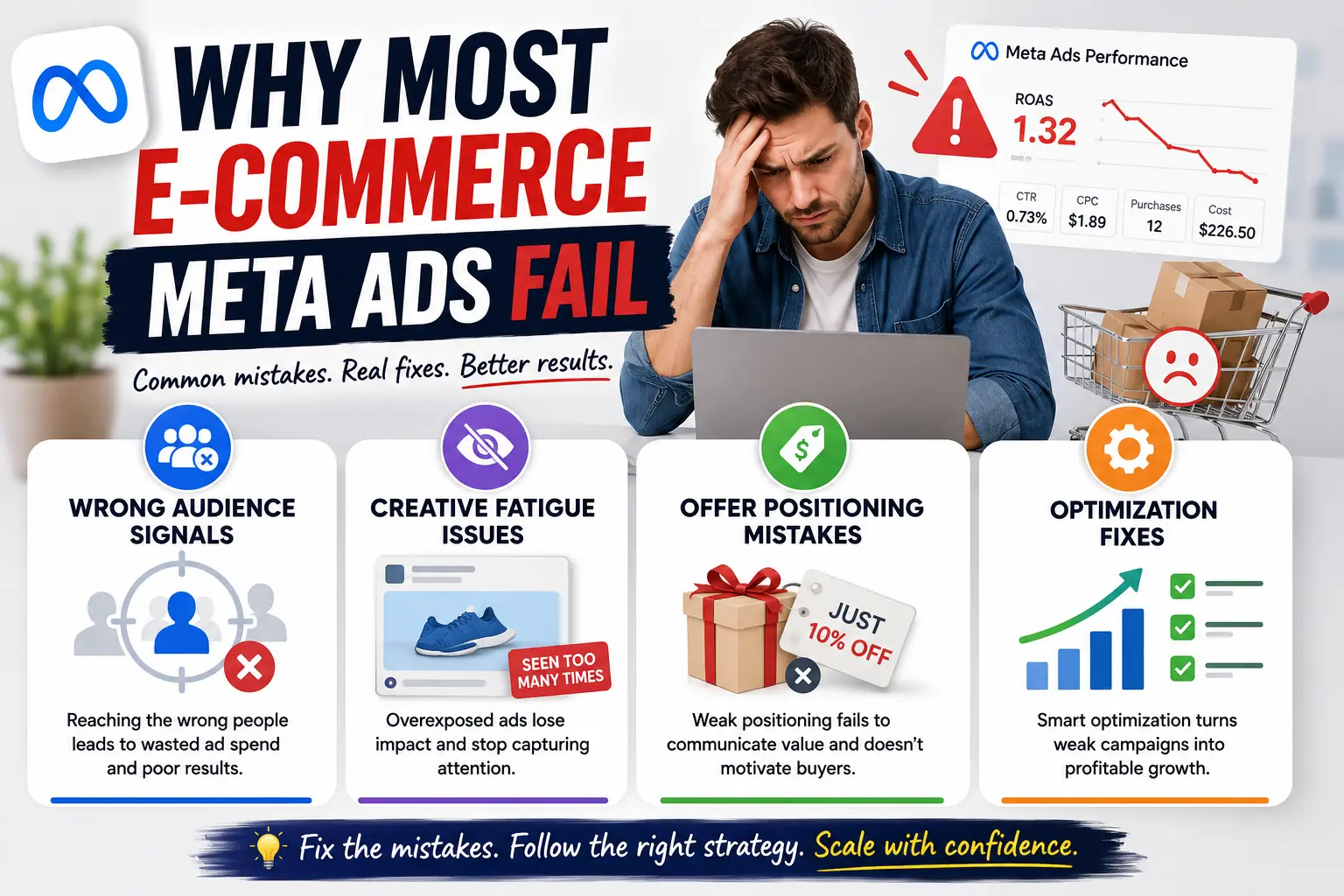
Wrong Audience Signals: A Hidden Reason Most E-commerce Meta Ads Fail
Many e-commerce brands believe their Meta ads fail because of weak creatives or small budgets. While those factors matter, another issue often causes bigger problems.
The issue is sending wrong audience signals.
Meta’s advertising system is incredibly powerful. It uses data and machine learning to find people likely to engage and buy. However, the platform can only work with the information you provide.
If you send confusing or inaccurate signals, Meta struggles to identify the right customers. As a result, your ads reach people who are unlikely to purchase.
This leads to wasted ad spend, lower conversion rates, and disappointing campaign performance.
The good news is that audience signal problems are usually fixable. Once you understand them, you can improve targeting and help Meta find better buyers.
What Are Audience Signals?
Audience signals are pieces of information that help Meta understand who your ideal customers are.
These signals come from many sources.
For example, Meta learns from:
- Website visitors
- Product viewers
- Add-to-cart users
- Past customers
- Video viewers
- Lead form submissions
- Social media engagement
Every action gives Meta clues about customer behavior.
When enough quality signals exist, the platform becomes better at finding similar people.
Think of audience signals as directions for a navigation system.
Good directions help you reach the correct destination. Poor directions increase the chances of getting lost.
The same principle applies to Meta advertising.
The better your signals, the better your targeting becomes.
Targeting Everyone Usually Targets No One
Many advertisers try to reach as many people as possible.
This seems logical at first.
A larger audience appears to create more opportunities. However, broad targeting without strategy often creates weak results.
If your audience includes people with little interest in your products, Meta receives mixed signals.
The platform starts learning from low-quality interactions.
For example, imagine selling premium skincare products while targeting a broad audience interested in general beauty content.
Many users may engage with your ads. However, not all of them can afford your products.
Meta may optimize toward engagement instead of purchases.
This creates misleading performance data.
The solution is focusing on audience quality rather than audience size.
Smaller, more relevant audiences often produce stronger results.
Optimizing for the Wrong Objective
One of the biggest audience signal mistakes happens during campaign setup.
Many advertisers choose objectives that do not match business goals.
For example, if your goal is sales, optimizing for page likes creates a problem.
Meta will search for people likely to like content.
Unfortunately, people who enjoy clicking like buttons are not always buyers.
The platform follows your instructions precisely.
If you ask for engagement, it finds engagement.
If you ask for purchases, it searches for potential buyers.
This distinction is extremely important.
Always align campaign objectives with desired outcomes.
The right objective sends stronger audience signals and improves campaign performance.
Low-Quality Traffic Creates Poor Signals
Not all website visitors have equal value.
Some visitors arrive because they are genuinely interested. Others click accidentally or out of curiosity.
If large amounts of low-quality traffic enter your website, Meta learns from the wrong people.
This can weaken future targeting.
For example, misleading headlines may attract many clicks. However, visitors quickly leave because expectations are not met.
The result is high traffic but poor conversions.
Meta sees activity but receives confusing purchase signals.
Over time, campaign performance may decline.
Focus on attracting visitors who match your ideal customer profile.
Quality traffic provides stronger learning opportunities for Meta’s algorithm.
Ignoring Customer Data
Many brands overlook one of their most valuable assets.
Their existing customers.
Past buyers provide some of the strongest audience signals available.
These people have already demonstrated purchase intent.
Their behavior helps Meta understand what successful customers look like.
If you ignore customer data, you miss an important opportunity.
Customer lists, website purchase events, and repeat buyer behavior all contribute valuable insights.
The more quality customer information you provide, the smarter Meta’s targeting becomes.
Many successful advertisers build campaigns around customer-based audiences.
This creates stronger audience signals and often improves overall campaign efficiency.
Confusing the Algorithm With Constant Changes
Meta’s algorithm needs time to learn.
Frequent changes can interrupt this learning process.
Many advertisers modify audiences, budgets, creatives, and objectives every few days.
While experimentation matters, excessive adjustments can create confusion.
Imagine teaching someone a new skill while changing instructions constantly.
Progress becomes difficult.
The same challenge affects Meta’s learning system.
Each major change forces the platform to adapt again.
This slows optimization and reduces signal quality.
Instead, allow campaigns enough time to gather meaningful data.
Patience often improves results.
Strong audience signals develop through consistent learning.
Focus on Buyer Behavior, Not Vanity Metrics
Many advertisers become excited by likes, comments, and shares.
These metrics feel encouraging.
However, they do not always indicate buying intent.
Someone may enjoy your content but never purchase a product.
If Meta learns from engagement-only behavior, targeting quality may suffer.
Buyer behavior provides much stronger signals.
Actions such as:
- Product views
- Add-to-cart events
- Checkout initiations
- Purchases
- Repeat orders
These actions tell Meta which users are genuinely interested.
The platform can then search for similar prospects.
Always prioritize metrics connected to business growth.
Vanity metrics can be useful, but conversions matter most.
Build Stronger Signals Through Better Tracking
Accurate tracking plays a major role in audience signal quality.
When tracking systems work properly, Meta receives valuable customer behavior data.
The platform can identify patterns more effectively.
This improves optimization and targeting accuracy.
Make sure important customer actions are tracked correctly.
Every purchase, lead, and conversion helps strengthen audience signals.
Good tracking creates better learning opportunities for the algorithm.
Better learning usually leads to better performance.
Help Meta Find the Right People
Meta advertising success depends heavily on audience understanding.
The platform wants to find people likely to convert. However, it relies on the signals you provide.
When signals are inaccurate, confusing, or incomplete, campaign performance often suffers.
That is why many e-commerce Meta ads fail.
The problem is not always the creative. It is not always the budget.
Often, the issue starts with audience signals.
By focusing on quality data, correct objectives, customer behavior, and accurate tracking, you help Meta make smarter decisions.
The result is better targeting, stronger conversions, and more efficient ad spending.
When you give Meta the right signals, it becomes much easier to connect your products with people who actually want to buy them.
Creative Fatigue Issues: Why Your Meta Ads Stop Working
You launch a Meta ad campaign and everything looks great. Clicks increase, sales arrive, and return on ad spend improves.
Then something strange happens.
Results begin to decline. Costs increase. Engagement drops. Sales become less consistent.
Many e-commerce brands immediately blame targeting, budgets, or competition. While those factors can affect performance, another common problem often goes unnoticed.
That problem is creative fatigue.
Creative fatigue happens when your audience sees the same advertisement too many times. Over time, people become familiar with the ad and stop paying attention.
Even the best-performing creative eventually loses its impact.
Understanding creative fatigue can help you protect campaign performance and keep your Meta ads producing results longer.
What Is Creative Fatigue?
Think about hearing the same song every day.
At first, you may enjoy it. After several weeks, excitement fades. Eventually, you may skip it entirely.
The same thing happens with advertisements.
When users repeatedly see identical creatives, their interest decreases.
The ad no longer feels new. It no longer captures attention.
As a result, people engage less often. Click-through rates decline. Conversion rates may decrease as well.
Meta’s algorithm notices these changes.
When engagement falls, ad delivery often becomes less efficient. Costs begin rising while performance drops.
This is why creative fatigue remains one of the most common reasons e-commerce Meta ads fail.
Why Creative Fatigue Happens Faster Than You Think
Many advertisers assume creative fatigue only affects large campaigns.
In reality, it can happen to businesses of all sizes.
If your audience is relatively small, the same people may see your ad repeatedly.
Even if your audience is large, successful campaigns often show ads frequently to highly engaged users.
Over time, repeated exposure creates familiarity.
Familiarity is not always beneficial in advertising.
At some point, users stop noticing the ad completely.
This phenomenon is often called banner blindness.
People scroll past content they have already seen many times.
Your advertisement becomes part of the background rather than something worth attention.
The more frequently this occurs, the weaker campaign performance becomes.
Warning Signs Your Creatives Are Getting Tired
Creative fatigue rarely appears overnight.
Usually, there are warning signs before performance declines significantly.
One common indicator is a falling click-through rate.
People see the ad but no longer feel motivated to click.
Another sign is increasing cost per result.
Meta must work harder to generate conversions because audience engagement decreases.
You may also notice lower conversion rates.
Website visitors continue arriving, but fewer complete purchases.
Frequency metrics can provide additional clues.
Frequency measures how often the average person sees your ad.
Higher frequency levels often increase the risk of creative fatigue.
When several warning signs appear together, your creatives may need refreshing.
Great Ads Do Not Last Forever
One mistake many advertisers make is assuming a winning creative will continue performing forever.
Unfortunately, every ad has a lifespan.
Some creatives remain effective for months. Others lose momentum within weeks.
Audience behavior constantly changes.
Consumer preferences evolve. Market conditions shift. Competitors launch new campaigns.
Even if your product remains excellent, your creative message may eventually feel outdated.
This is perfectly normal.
Successful advertisers understand that creative replacement is part of the process.
Instead of hoping an ad lasts forever, they prepare new concepts continuously.
This proactive approach helps maintain performance stability.
Refreshing Creatives Does Not Mean Starting Over
Many businesses worry about creative fatigue because they think creating new ads requires enormous effort.
Fortunately, refreshing creatives does not always require complete redesigns.
Small changes can often create significant improvements.
You can update:
- Headlines
- Opening hooks
- Product images
- Video intros
- Customer testimonials
- Calls to action
For example, a new opening sentence may dramatically improve attention.
A different customer story may resonate with a new audience segment.
Even changing visual presentation can make an ad feel fresh again.
The goal is introducing enough variation to regain audience interest.
Build a Creative Testing System
The best defense against creative fatigue is continuous testing.
Instead of relying on one winning creative, develop multiple versions regularly.
Think of creative testing as maintaining a healthy inventory.
When one ad begins losing effectiveness, another creative is ready to take its place.
You can test:
- Different creative angles
- New video styles
- User-generated content
- Product demonstrations
- Educational content
- Problem-solution formats
This approach keeps campaigns dynamic.
It also helps you discover new winners before performance problems appear.
Brands that test consistently usually recover from creative fatigue faster.
Use Audience Insights to Create Better Variations
Audience feedback can inspire fresh creative ideas.
Pay attention to customer reviews, comments, and support inquiries.
Customers often reveal concerns, goals, and motivations through their conversations.
These insights can become powerful creative themes.
For example, if customers frequently mention convenience, create ads highlighting time-saving benefits.
If customers discuss product quality, build creatives around craftsmanship and reliability.
Audience-driven creatives often feel more relevant because they address real customer interests.
The more closely your messaging reflects customer priorities, the stronger engagement tends to become.
Avoid Overloading a Single Creative
When advertisers discover a winning ad, they often increase spending aggressively.
While this can generate short-term growth, it may accelerate fatigue.
The same audience sees the ad more frequently.
Interest declines faster.
A smarter strategy involves spreading budget across multiple strong creatives.
This reduces pressure on individual ads.
It also gives Meta more options for optimization.
A diversified creative portfolio often produces more stable long-term performance.
Instead of relying on one star performer, you create several reliable contributors.
Keep Your Ads Fresh and Relevant
Creative fatigue is not a sign of failure.
It is a natural part of digital advertising.
Every successful e-commerce brand eventually experiences it.
The difference is how brands respond.
Weak advertisers ignore the warning signs and hope results improve.
Successful advertisers refresh creatives, test new concepts, and adapt quickly.
They understand that attention is one of the most valuable resources online.
To keep earning that attention, your ads must stay fresh, relevant, and engaging.
Make Creative Renewal a Habit
The most effective Meta advertisers treat creative development as an ongoing activity.
They never stop generating ideas.
They continuously test new hooks, visuals, and messaging approaches.
This mindset creates a steady stream of fresh content.
As a result, campaigns remain more resilient against fatigue.
Instead of reacting to declining performance, you stay ahead of the problem.
That is why understanding creative fatigue is so important.
Many e-commerce Meta ads fail because advertisers rely on the same creatives for too long.
When you regularly refresh your ads and maintain a strong testing process, you give your campaigns a much better chance of delivering consistent growth and long-term profitability.
Offer Positioning Mistakes: Why Great Products Still Fail in Meta Ads
Many e-commerce business owners believe that a great product automatically leads to successful advertising.
Unfortunately, that is not always true.
You can have an amazing product, attractive packaging, and competitive pricing. Yet your Meta ads may still struggle to generate sales.
The reason often comes down to offer positioning.
Offer positioning is how you present your product to potential customers. It shapes how people perceive value, relevance, and urgency.
When positioning is weak, even excellent products can get ignored.
When positioning is strong, average products can sometimes outperform expectations.
This is why offer positioning mistakes remain one of the biggest reasons e-commerce Meta ads fail.
A Great Product Does Not Sell Itself
Many business owners fall in love with their products.
That is understandable. You know the effort, research, and quality behind what you sell.
However, customers do not see your product through the same lens.
They do not know your story yet.
Instead, they ask simple questions:
- Why should I care?
- How does this help me?
- Is this worth my money?
- Why should I choose this over alternatives?
If your ad fails to answer these questions quickly, people keep scrolling.
Remember that customers buy solutions, not products.
They care about outcomes and benefits more than features.
Your positioning should focus on what changes for the customer after purchasing.
The clearer the benefit, the stronger the offer becomes.
Focusing on Features Instead of Benefits
One of the most common positioning mistakes is highlighting features without explaining benefits.
Features describe what a product has.
Benefits explain why those features matter.
For example, imagine selling a water bottle.
A feature might be double-wall insulation.
A benefit might be cold water for twelve hours during hot summer days.
Most customers connect emotionally with benefits.
They picture themselves enjoying the result.
The feature simply supports the promise.
When your Meta ads focus only on technical details, people may lose interest quickly.
Instead, translate features into meaningful outcomes.
Show customers how their lives improve after using your product.
Benefits create stronger emotional connections and often drive more conversions.
Trying to Appeal to Everyone
Many advertisers make their offers too broad.
They try to attract every possible customer.
Unfortunately, broad messaging often becomes weak messaging.
When you speak to everyone, nobody feels specifically understood.
Imagine selling premium fitness equipment.
One ad targets weight loss seekers, athletes, seniors, and busy parents simultaneously.
The message becomes scattered.
Each audience has different goals and motivations.
A stronger approach focuses on one audience segment at a time.
For example, you might create an offer specifically for busy professionals.
Now your message becomes more relevant and persuasive.
Specificity helps customers feel like the product was designed for them.
That feeling increases engagement and conversion potential.
Weak Value Propositions Confuse Customers
Your value proposition explains why customers should choose your product instead of competitors.
Many e-commerce brands struggle because their value proposition is unclear.
Customers see the ad but fail to understand what makes the product unique.
If your offer sounds similar to dozens of competitors, people have little reason to act.
Ask yourself:
- What makes this product different?
- What problem does it solve better?
- Why should customers trust it?
- What unique advantage exists?
The answers form the foundation of strong positioning.
When customers instantly understand your value, decision-making becomes easier.
Clarity often beats complexity in advertising.
Overusing Discounts and Price Promotions
Discounts can increase sales temporarily.
However, relying on discounts too often creates problems.
Customers may begin associating your brand only with lower prices.
This weakens perceived value.
If your positioning depends entirely on discounts, competitors can easily copy your strategy.
Someone else can always offer a bigger discount.
Instead, focus on communicating value.
Explain quality, convenience, results, reliability, or customer experience.
Price matters, but value matters more.
Many customers willingly pay extra when they understand the benefits.
Strong positioning helps justify pricing and reduce dependence on constant promotions.
Ignoring Customer Pain Points
People buy products because they want to solve problems.
If your offer ignores customer challenges, engagement often suffers.
The best Meta ads show a deep understanding of customer frustrations.
For example, a skincare brand should not simply showcase product ingredients.
Instead, it can address concerns about acne, confidence, or skin irritation.
A home organization product should focus on reducing clutter and stress.
The more accurately you identify pain points, the more relevant your offer becomes.
Customers pay attention when they feel understood.
This emotional connection often creates stronger advertising results.
Forgetting the Emotional Side of Buying
Many purchases involve emotions.
Even practical products trigger emotional responses.
Customers may seek confidence, comfort, convenience, security, happiness, or status.
Yet many advertisers focus only on logic.
They discuss specifications, dimensions, and technical details.
While these details matter, emotions often drive action.
Think about how your product makes customers feel.
Does it save time?
Does it reduce stress?
Does it improve confidence?
Does it create excitement?
Emotional positioning helps customers imagine positive outcomes.
That imagination often influences buying decisions.
The strongest offers combine emotional appeal with logical support.
Poor Messaging Creates Lost Opportunities
Even strong offers can fail when messaging is unclear.
Complicated language creates confusion.
Industry jargon creates distance.
Long explanations reduce attention.
Meta users scroll quickly.
You have only a few seconds to communicate value.
This is why simple messaging performs so well.
Focus on one main promise.
Highlight one clear benefit.
Use language that feels natural and easy to understand.
Simple communication helps customers process information faster.
When understanding increases, conversion rates often improve.
Test Different Positioning Angles
Many advertisers assume there is only one way to present a product.
In reality, every product can support multiple positioning angles.
For example, a meal delivery service could focus on:
- Saving time
- Eating healthier
- Reducing cooking stress
- Supporting fitness goals
Each angle appeals to different motivations.
Testing these variations helps identify what resonates most strongly with your audience.
Meta advertising provides excellent opportunities for experimentation.
Small positioning adjustments can create significant performance improvements.
Never assume your first message is the best message.
Continuous testing often reveals surprising insights.
Position Your Offer Around Customer Value
At its core, offer positioning is about helping customers understand value.
People need a clear reason to stop scrolling and pay attention.
They need a clear reason to trust your product.
They need a clear reason to choose you over alternatives.
When positioning focuses on customer needs, benefits, and outcomes, advertising becomes more effective.
When positioning focuses only on products, features, and discounts, performance often suffers.
That is why many e-commerce Meta ads fail.
The problem is not always the product itself.
Often, the issue is how the offer is presented.
By improving your positioning, clarifying value, and focusing on customer outcomes, you can create stronger ads that attract attention, build trust, and generate more sales.
Optimization Fixes: How to Turn Struggling Meta Ads Into Winners
Many e-commerce brands launch Meta ads with high expectations. They create attractive creatives, choose audiences, and set budgets carefully.
Then the results arrive.
Sales remain low. Costs increase. Return on ad spend falls below expectations.
At this stage, many advertisers assume their campaigns have failed completely.
Fortunately, that is not always true.
In many cases, the issue is not the product, audience, or platform. The problem is a lack of proper optimization.
Optimization is the process of improving campaign performance through small, data-driven adjustments.
Successful Meta advertisers rarely rely on luck. Instead, they continuously analyze results and make improvements.
These optimization fixes often separate profitable campaigns from disappointing ones.
Stop Making Decisions Too Quickly
One of the most common optimization mistakes is impatience.
Many advertisers launch a campaign and expect immediate results.
After a day or two, they start changing budgets, audiences, and creatives.
This creates problems.
Meta’s algorithm needs time to learn. During the learning phase, performance may fluctuate naturally.
Frequent adjustments interrupt this process.
Imagine trying to teach someone a new skill while changing instructions every hour.
Progress becomes difficult.
The same thing happens inside Meta’s advertising system.
Allow campaigns enough time to gather meaningful data.
Patience often produces better optimization decisions.
The goal is making informed changes rather than emotional reactions.
Focus on Metrics That Matter
Many advertisers become distracted by vanity metrics.
Likes, comments, and shares can feel encouraging.
However, these numbers do not always lead to sales.
Optimization should focus on metrics connected to business goals.
Important metrics often include:
- Cost per purchase
- Return on ad spend
- Conversion rate
- Cost per acquisition
- Checkout completion rate
These measurements provide valuable insights into campaign performance.
For example, high traffic with low conversions may indicate landing page issues.
Strong engagement with weak sales may suggest offer positioning problems.
The right metrics help you identify the real source of performance challenges.
Improve Your Creative Performance
Creative quality plays a major role in Meta advertising success.
Even perfect targeting struggles when creative performance is weak.
Review your advertisements carefully.
Ask yourself:
- Does the ad capture attention quickly?
- Is the message clear?
- Does the visual stand out?
- Is the call to action obvious?
Many successful ads communicate their message within seconds.
People scroll quickly through social media.
If your creative fails to grab attention immediately, opportunities disappear.
Testing new headlines, images, videos, and hooks can often improve results significantly.
Small creative improvements sometimes generate surprisingly large performance gains.
Strengthen Your Landing Page Experience
Many advertisers focus heavily on ads while ignoring what happens afterward.
A great advertisement can bring visitors to your website.
However, the website must complete the conversion process.
If your landing page creates confusion, sales may suffer.
Review your customer experience carefully.
Consider factors such as:
- Page loading speed
- Mobile usability
- Product descriptions
- Checkout simplicity
- Trust signals
Slow pages often increase abandonment rates.
Complicated checkout processes can reduce conversions.
Customers expect fast and smooth experiences.
The easier it becomes to buy, the better your results often become.
Optimization should always include both ads and landing pages.
Refine Audience Quality
Not every audience delivers equal results.
Some audiences generate engagement. Others generate purchases.
Understanding this difference is critical.
Review audience performance regularly.
Identify which segments convert most efficiently.
Look for patterns among your best customers.
You may discover specific interests, demographics, or behaviors that consistently perform better.
Once identified, allocate more resources toward those audiences.
At the same time, reduce spending on weak performers.
Audience optimization helps improve efficiency and reduce wasted budget.
Better audiences usually lead to better outcomes.
Fix Conversion Tracking Problems
Optimization becomes difficult when data is inaccurate.
If conversion tracking is incomplete or incorrect, decision-making suffers.
Meta relies heavily on conversion data for optimization.
Without reliable information, the platform struggles to identify valuable users.
Verify that important events are tracked correctly.
Ensure purchases, leads, and other key actions appear accurately in reports.
Regular tracking audits can prevent costly mistakes.
Good optimization starts with trustworthy data.
The more accurate your tracking system becomes, the more effective your optimization efforts become.
Refresh Fatigued Creatives
Creative fatigue is a common performance killer.
Even successful ads lose effectiveness over time.
Audiences eventually stop paying attention to familiar content.
Signs of fatigue often include:
- Rising costs
- Lower click-through rates
- Declining engagement
- Reduced conversions
When these symptoms appear, refreshing creatives can help.
You do not always need completely new campaigns.
Sometimes simple adjustments are enough.
A new headline, image, hook, or customer testimonial may restore performance.
Fresh content keeps audiences interested and helps maintain campaign momentum.
Optimize Budgets Carefully
Budget optimization requires balance.
Increasing spending too aggressively can disrupt performance.
Reducing budgets too quickly can limit growth opportunities.
Instead, make gradual adjustments.
Allow campaigns to stabilize before evaluating results.
If a campaign consistently performs well, consider increasing budgets slowly.
Monitor performance after each change.
This measured approach often produces more stable growth.
Optimization is about improving efficiency, not creating unnecessary volatility.
Small changes frequently outperform dramatic adjustments.
Learn From Both Winners and Losers
Many advertisers only analyze successful campaigns.
This approach misses valuable learning opportunities.
Poor-performing campaigns often reveal important insights.
A weak creative may highlight messaging problems.
A failed audience may reveal targeting limitations.
A low-converting offer may expose positioning issues.
Every campaign generates feedback.
The key is interpreting that feedback correctly.
Instead of viewing poor results negatively, treat them as useful information.
Each lesson helps improve future performance.
Optimization becomes easier when every outcome contributes to learning.
Build an Ongoing Optimization Process
The most successful e-commerce brands never stop optimizing.
They understand that advertising environments change constantly.
Customer preferences evolve. Competitors adjust strategies. Market conditions shift.
Continuous optimization helps maintain competitiveness.
Create a routine for reviewing campaign performance.
Analyze data regularly. Test new ideas consistently. Improve weak areas systematically.
This process creates long-term advantages.
Rather than relying on occasional successes, you develop predictable growth systems.
Small Improvements Create Big Results
Many people think optimization requires major changes.
In reality, small improvements often produce impressive outcomes.
A slightly better headline can increase clicks.
A faster landing page can improve conversions.
A stronger audience can lower acquisition costs.
When multiple small improvements combine, overall performance improves dramatically.
That is the power of optimization.
Most e-commerce Meta ads fail not because success is impossible. They fail because advertisers stop improving too soon.
The brands that succeed keep testing, learning, and refining.
They understand that optimization is not a one-time task.
It is an ongoing process that transforms average campaigns into profitable growth engines.
When you commit to continuous optimization, your Meta ads become stronger, more efficient, and far more capable of driving long-term business success.
Leave a Comment